

The Four Pillars of an Intelligent System (And How to Prepare Your Business for AI)
Most entrepreneurs I speak with are already trying to bring AI into their business. They test tools, save prompts, and hope something will finally make the day run smoother. But even with all that effort, the business still feels heavier than it should. Decisions take too long. Teams rely on workarounds. Information lives in too many places. And instead of making things easier, AI often becomes just one more thing to manage.
The real issue is not the tools themselves. It is the systems underneath them. AI does not create clarity on its own. It only works well when the business already runs with some level of structure and consistency. Without that foundation, even the smartest tools end up sitting on top of messy processes.
So before thinking about which AI features to use, it helps to understand what your business needs first: a clear operational foundation and the right systems to support it. When those pieces are in place, AI does not just help - it amplifies everything. Your workflows become smoother, your data becomes more trustworthy, and your team spends more time doing meaningful work instead of chasing information.
That is where the four pillars of an intelligent system come in. They give you a simple way to understand what your business needs so AI can actually work for you instead of adding to the chaos. They give you a simple way to understand what your business needs so AI can actually help you scale instead of adding to the chaos.
AI Readiness: Why Most AI Efforts Fail Before They Begin
Before you look at tools or think about automation, your business needs a clear operational foundation. Most AI projects fail not because the technology is flawed, but because the business was not ready for AI to support its workflows.
AI readiness is about making sure your business has the clarity AI depends on. When workflows are unclear or information is scattered, AI will only magnify the problem. Readiness simply means understanding how your business works today and making sure the essentials are clear and consistent.
Once that foundation is in place, AI becomes much easier to implement and far more effective in real day to day operations. With that clarity established, you can start building the systems that support your business. These four pillars form the backbone of every intelligent system we build.
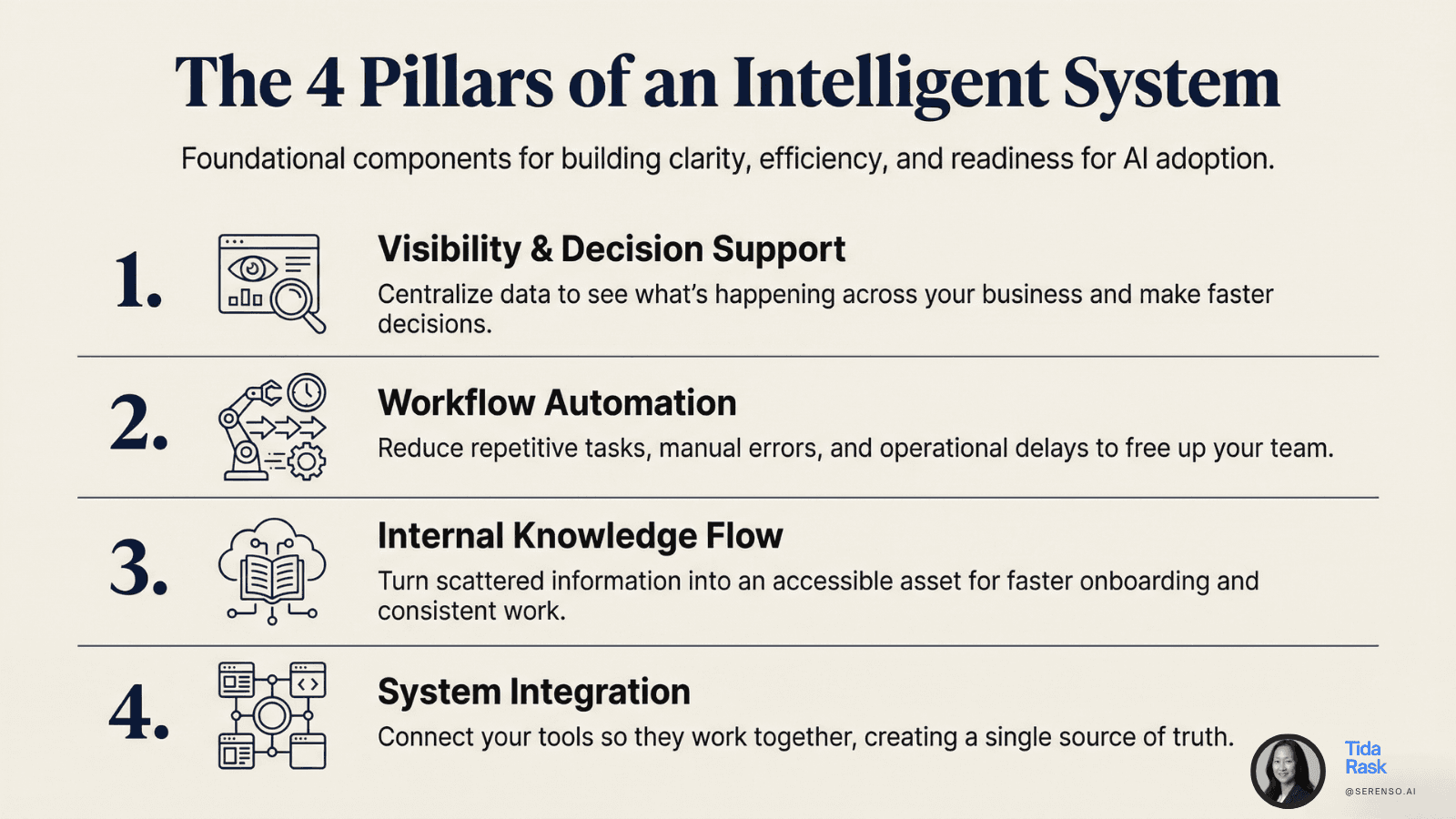
The Four Pillars of an Intelligent System
Think of these not as individual tools, but as the core pillars of a modern intelligent system, the same areas we focus on when we build solutions for our clients.
1. Visibility and Decision Support
Most leaders rely on scattered data when making decisions. They bounce between tools, exports, and manual reports that only reflect part of the picture. A well designed visibility system changes that entirely. Instead of piecing information together, you can open one place and see what is happening across your business. The metrics that matter update automatically, trends become easier to spot, and you get notified when something needs attention. You can act on what you see without switching tabs or digging for context.
Strengthen visibility first and every other part of your operation becomes lighter.
Visibility is not just a set of metrics. It is the way information moves through your business and how easily you can interpret what is happening. When visibility is clear and consistent, your team stops guessing and starts operating with confidence.
What this improves:
You stop hunting for answers
You make decisions faster
Reporting no longer requires manual effort
2. Workflow Automation for Repetitive Tasks
Every growing business hits a point where the team becomes the bottleneck. Not because they lack skill, but because too much time is spent on repeatable tasks that follow the same steps every time. Automation reduces the friction in those processes so your team can focus on work that actually needs a human.
If document work slows your team down, I also wrote a detailed article about document automation and where it creates the fastest relief.
What this improves:
Lower operational overhead
Fewer delays and errors
Consistent handoffs between people and tools
3. Internal Knowledge Flow
Your knowledge lives in documents, inboxes, people’s memory, and half finished SOPs. When the business grows, this slows everything down. Improving your knowledge flow turns scattered information into something your team can use instantly and confidently..
What this improves:
Faster onboarding
Clear, consistent outputs
Less back and forth across departments
4. System Integration and Data Flow
If your tools do not talk to each other, everything feels heavier than it needs to be. Integration is not about software. It is about creating a clean path for your data to follow so your systems work together instead of in silos.
What this improves:
One source of truth across your tools
Fewer manual steps and duplicate work
A smoother experience for your team and customers
Reliable data that supports automation and reporting
The 80/20: Where to Start First
You do not need to strengthen all four areas at once. The fastest and most meaningful wins usually come from two places.
1. The workflows that drain your team daily
Examples include:
Manual follow ups
Rebuilding the same documents
Repeating communication steps
Passing tasks back and forth by hand
Once streamlined and automated, your team feels the relief immediately.
2. The visibility gaps that slow decision making
If you spend hours assembling data every week, you are not just losing time. You are losing clarity.
A modern visibility process gives you a clear picture of what is happening in the business without manual work.
The Reality: What It Actually Takes to Implement
AI tools are often marketed as quick fixes. In reality, the success of any AI system depends on the strength of the underlying process.
Here is what implementation really requires.
1. Clear workflows
If a process is unclear, automating it will not fix it. It will just make the confusion faster.
2. Clean, structured information
AI cannot clean up inconsistent data or missing documentation. It needs clarity to perform well.
3. Choosing solutions based on readiness
Not based on hype. Not based on what someone else is using. Based on what your business can absorb right now.
4. Implementing in sequence
When the order is wrong, systems break. When the order is right, everything becomes easier.
5. Time for optimization
Your team will use the new process in ways you cannot predict. That feedback is how the system becomes stronger.
The good news is that once the foundation is clear, AI stops feeling overwhelming. It becomes a natural extension of how your business already works.
Why These Four Pillars Cover Everything Your Business Needs
When you look at how any small or medium-size business actually runs, every operational challenge fits into one of these four pillars. Visibility, automation, knowledge flow, and integration are not just categories - they represent the core mechanics that allow a business to function smoothly.
If a team is struggling, it is almost always because:
They cannot see what is happening (visibility).
They are doing too much manual work (automation).
They cannot find or trust their internal knowledge (knowledge flow).
Their tools and data do not talk to each other (integration).
There is no operational issue that sits meaningfully outside these areas. Even problems that seem unrelated - like customer delays, inconsistent output, team burnout, or stalled growth - almost always trace back to one of these pillars.
This is why strengthening even one pillar creates noticeable relief. And strengthening all four gives your business the foundation of a modern intelligent system - one that is easy to run, easy to grow, and ready for AI.
Bringing It All Together
AI is not the starting point. Strong systems are. When your business has clarity, consistent workflows, and information that moves the way it should, AI becomes a powerful accelerator instead of another tool to manage.
These four pillars give you a simple way to understand what your business truly needs beneath the surface. Strengthen even one of them and your day starts to feel lighter. Strengthen all four and you have the foundation of a modern intelligent system - the kind that saves hours every week, reduces mistakes, and helps your team operate with more confidence.
If you want support building systems that match how your team actually works and create real space in your day, I would be glad to help.
Want help building the right systems for your business? Let’s talk.