

Dec 4, 2025
Documentation Automation: What Actually Works
Every growing business hits the same wall eventually.
You are taking on more work, serving bigger clients, and adding people. Somewhere along the way, documentation starts slowing everything down. Proposals take too long. Reports get delayed. Your best team members spend hours formatting instead of thinking.
I have watched this pattern repeat across industries for years. The organizations that break through are not the ones who hire more admin support or buy the flashiest tools. They are the ones who learn what to automate and what to leave alone..
The Real Problem Isn’t Volume
Most teams assume the problem is sheer quantity. Too many proposals, too many reports, too many recurring documents. So they look for tools that promise to create content faster.
That is the wrong focus.
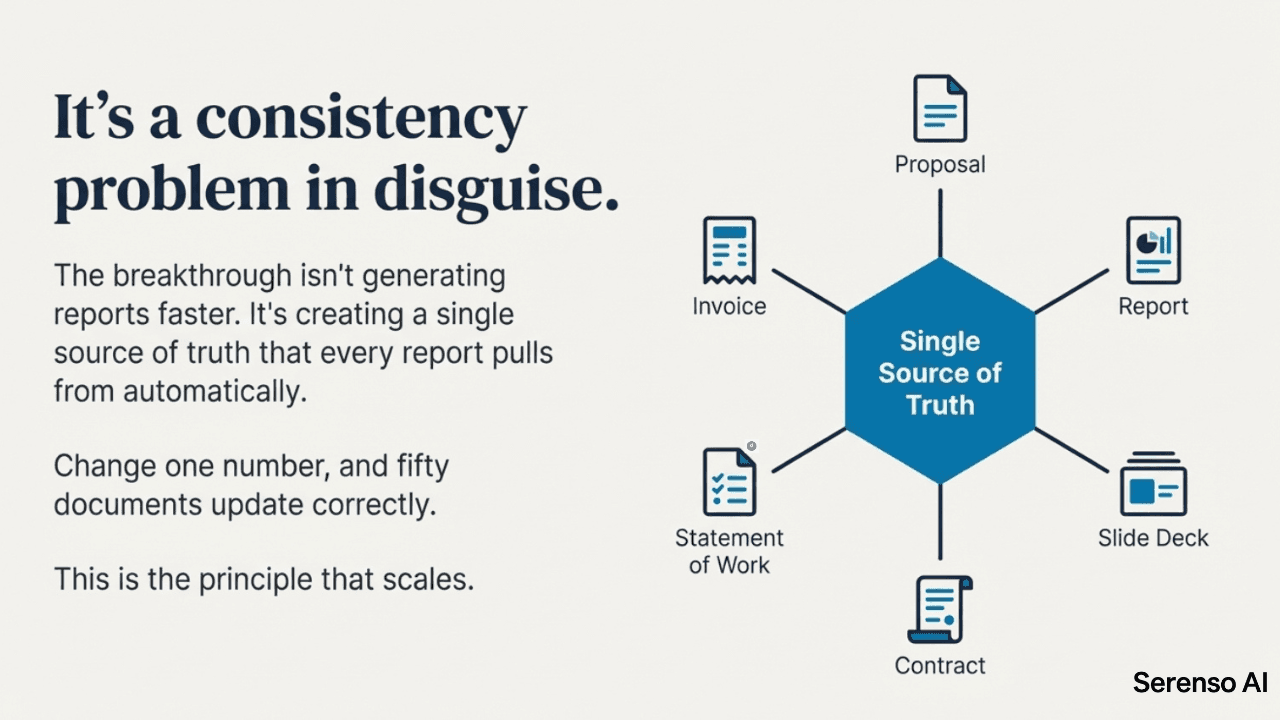
I have seen teams drown in auto-generated content that still needed heavy editing. I have seen businesses adopt automation tools that simply moved the bottleneck from creation to review. What looks like a volume problem is usually a consistency problem in disguise.
When I worked on reporting systems in financial services, we processed millions in transactions. The breakthrough was not faster report generation. It was having one source of truth that every report pulled from. Update a number once and fifty documents updated correctly.
Most businesses need the same principle, just applied differently.
What Actually Works
The teams that succeed with documentation automation tend to do three things well.
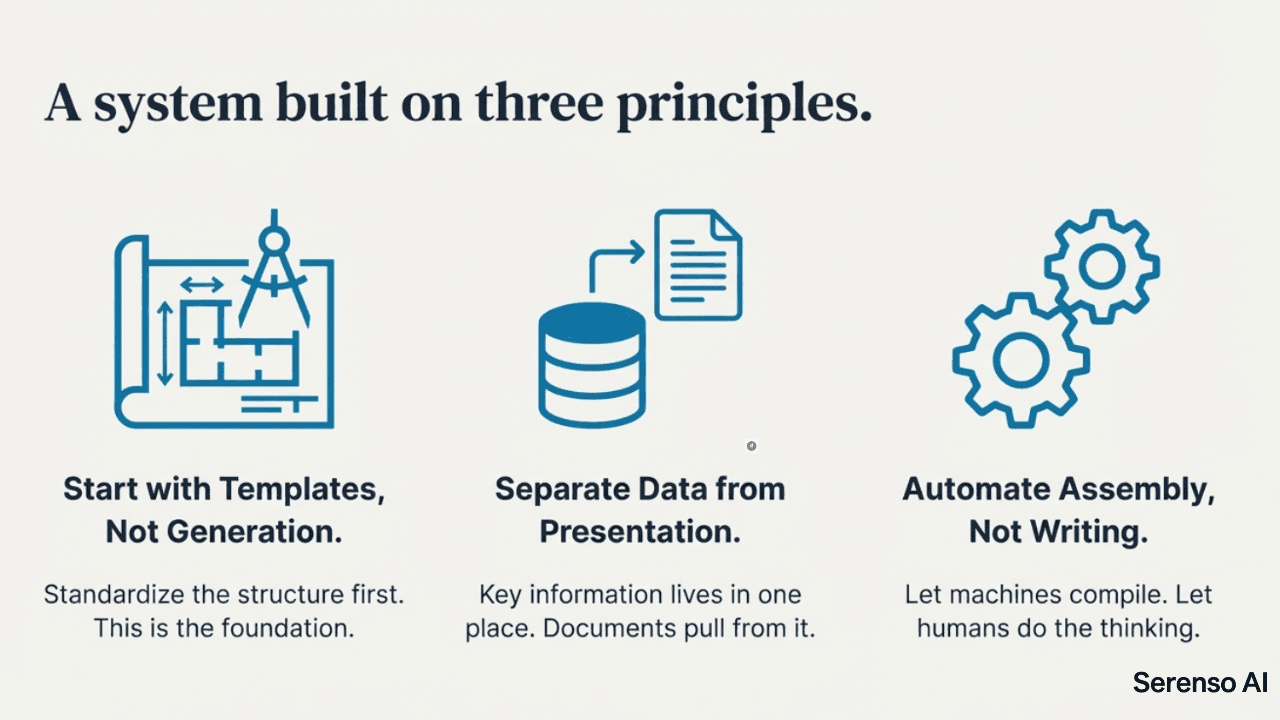
They start with templates, not generation.
Before you automate anything, you need clear structure. What belongs in every proposal or report. What sections never change. I have helped companies cut documentation time by more than half and the first step was always building a template library. It feels like busywork, but it is the foundation everything relies on.
They separate data from presentation.
Your client info, project details, metrics, and common language should live in one place. Your documents should pull from that source instead of copying it around. When the data layer is clean, your documents stay accurate without extra effort.
They automate assembly, not thinking.
This is where a lot of businesses get stuck. They try to automate the reasoning, the judgment, the part that actually requires expertise. That is backwards. Your team’s insight is the real value. Automation should handle the assembly: pulling the right sections, dropping in the right data, and formatting it correctly. Let people do the thinking. Let systems do the compiling.
A Practical Example
Here is a simple scenario based on patterns I have seen many times.
Imagine a growing service business that produces twenty proposals each month. Each proposal takes a senior team member about four hours to pull together. They search for case studies, gather details, reformat sections, and check every number by hand.
If you apply the right automation approach, you build three layers. First, a library of modular templates. Second, a shared data layer that connects to your CRM or internal systems. Third, an assembly process that pulls the correct pieces based on project type, client details, or scope.
The senior team member’s role shifts. Instead of four hours of assembly work, they spend thirty minutes reviewing and customizing. The thinking time stays the same. The manual work drops by eighty percent or more.
Multiply that across twenty proposals, and you recover real capacity without adding headcount.
Where Firms Go Wrong
I’ve watched smart teams make the same mistakes repeatedly.
They buy tools before they define their process. No software can fix unclear expectations about what a document should contain.
They try to automate everything at once. It is far better to start with the one document type you use most. Get that working before expanding.
They forget about maintenance. Templates age. Data changes. Connections break. Someone has to keep the system healthy or accuracy fades over time.The Bottom Line
The Bottom Line
Automation is not about replacing judgment. It is about removing friction so your best people can do their best work.
Teams that get this right move faster, deliver more consistently, and avoid costly errors. They also free up capacity for the strategic work that actually differentiates them.
If you feel like you are spending too much time assembling documents and not enough time improving their quality, that is a solvable problem. You just need to start in the right place.
At Serenso AI, we help business build documentation systems that actually work. If you’re curious whether your current approach is leaving capacity on the table, let’s talk.