
Dec 1, 2025
The Command Center Every Scaling Founder Needs But Doesn’t Have
If you are running a growing services business, you probably know this morning routine. You check your CRM for pipeline, switch to your project management tool for delivery status, open a spreadsheet someone emailed with utilization numbers, then scroll Slack to see what blew up overnight.
By 9:30, you have touched four systems and still do not know if you are actually on track.
This is not a tools problem. It is a visibility problem. And it gets more painful as you scale.
What I Have Learned About Information Chaos
I have seen this happen again and again. A company hits around 30 to 50 people and suddenly the founder cannot see the business anymore. The data exists, but it is scattered across systems that were never meant to work together.
I worked with a financial services firm that scaled from 12 to 300 employees. Early on, the CEO knew every deal, every project, every priority. By the time we reached 80 people, he was flying blind. The tools were fine. Salesforce worked. The project management system worked. The issue was simple but real. Nobody had time to connect the dots.
In practice, this showed up in small but costly ways. Sales would close a large deal, but delivery did not know the timeline commitments. Delivery would flag capacity issues, but sales kept selling because they could not see utilization in real time. Critical information lived in silos, and by the time someone manually pulled everything together, decisions were already made.
The companies that scaled smoothly were not the ones with better tools. They were the ones with better visibility.
The Real Solution Is Not Another Dashboard
Most founders try to solve the problem by building more dashboards. I have done it too. You pick a BI tool, spend weeks pulling data together, and end up with something that looks impressive but does not help you run the business day to day.
Traditional dashboards are backward looking. They show what happened, not what needs your attention right now.
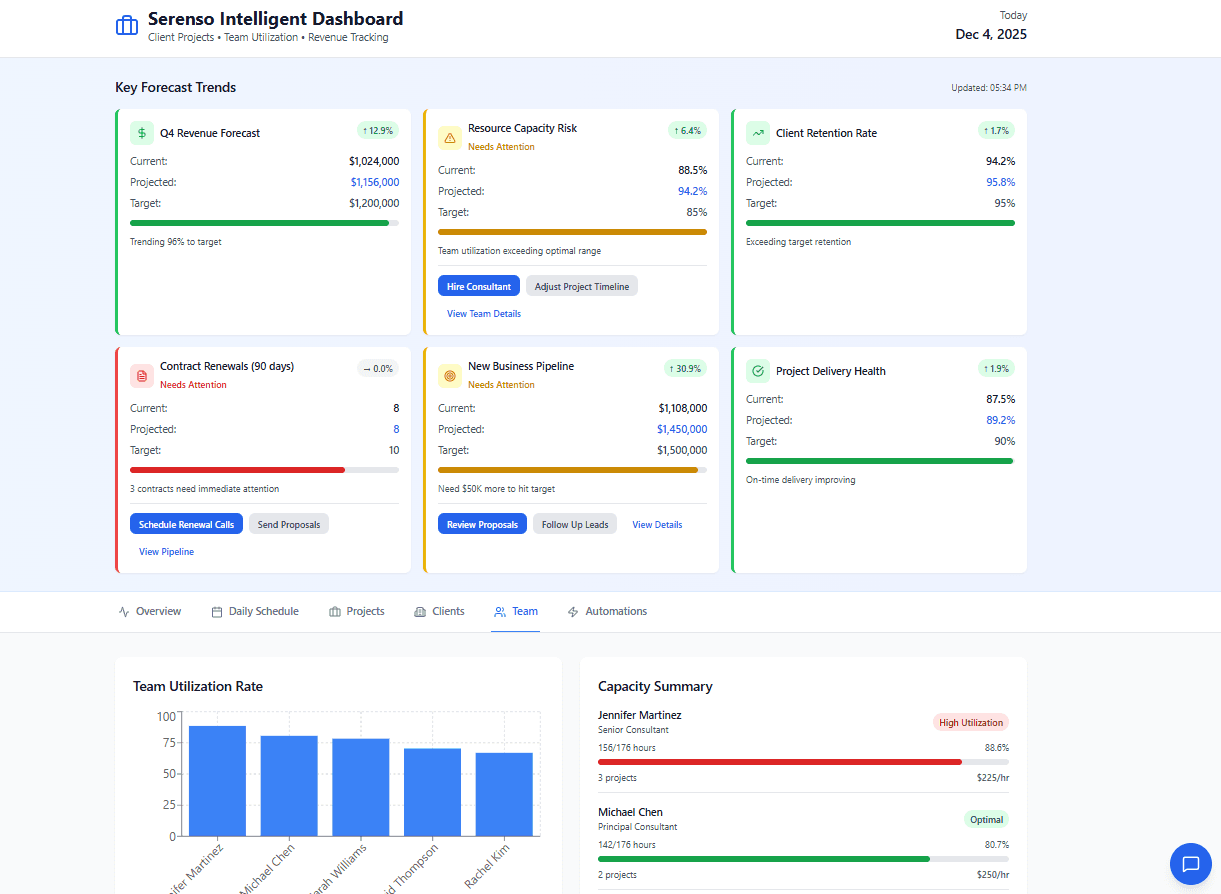
What growing teams actually need is a command center. One clear view that answers the questions you would ask if you had time to dig through every system.
Where is the pipeline really at, and which deals need attention
Which clients are healthy and which ones are quietly drifting
How team capacity lines up with upcoming work
Which operational metrics are starting to move the wrong way
And the real value is not the static numbers. It is the changes and patterns. Revenue might look stable this month, but three key accounts have not engaged in 30 days. That is the insight that matters.
How This Works in Practice
Here is a simple scenario based on systems I have built before.
Imagine you are leading a 50 person services firm. You open your morning view and see that your pipeline is strong at two million dollars, but close rates dropped fifteen percent this month. Delivery utilization is at seventy eight percent, which is fine, but two consultants roll off next week with no assignments lined up. One long term client has gone quiet after years of steady communication.
Without this view, you discover the utilization gap when someone asks for time off. You notice the client issue when renewal time arrives. The pipeline trend stays invisible until the end of the month.
With a command center, you can address these issues early. You can ask the sales lead about close rates before lunch. You can talk to delivery about the consultants rolling off while you still have options. You can have someone reach out to the quiet client today instead of waiting.
You can also act directly without opening five other tools. A stalled deal can be reassigned. A forecast dip can prompt a hiring adjustment. Small moves made at the right time make a real difference.
This is why I think of it as a command center instead of a dashboard. It is not about having all the data. It is about having the right information surfaced at the right moment so you can do something with it.
Start With What You Actually Need to See
If this sounds familiar, do not start by trying to connect everything you own. Start with the questions you ask yourself every morning. For most growing teams, they fall into three categories: pipeline health, client status, and team capacity.
Build visibility into those first. Make sure the information updates automatically, highlights changes, and prompts action. You can add more once the foundation is solid.
The goal is not perfect data. The goal is getting your mornings back and making better decisions before small problems turn into bigger ones.
If you want to see how we approach this with the CommandPost™ Dashboard at Serenso AI, I am happy to walk you through it.